


Network01
Network Vulnerability Assessment
We review your internal and external network for missing patches, weak configurations, exposed services, and default credentials, the backbone of most assessments.
Analyst-validated vulnerability assessment services across network, web, cloud, and IoT/OT. We find and rank every weakness, cut the false positives, and hand you a short, prioritized list of what to fix first, not a 200-page scan export nobody acts on.
A vulnerability assessment is a systematic review of your systems to identify, classify, and prioritize security weaknesses. It answers a simple question: where are we exposed, and how bad is each gap? The output is a ranked list of vulnerabilities with severity ratings, business context, and remediation guidance, so your team knows exactly what to fix first.
Hundreds of findings, plenty of false positives, ranked by generic severity. Volume without business context.
An analyst validates every finding, cuts the noise, and ranks what is left by real business risk. A short list you can act on.
A vulnerability assessment is broad; a penetration test is deep. The assessment maps every unlocked door and window; the test walks through one to prove what an attacker could reach. Run together, they are known as VAPT. For the full background, read our guide to penetration testing and assessments.
Different assets hide different weaknesses, so we scope the assessment to what you actually run, then bring the same analyst-led validation to each layer of your estate.
We review your internal and external network for missing patches, weak configurations, exposed services, and default credentials, the backbone of most assessments.
We assess your web apps against known weakness classes, including the OWASP Top 10, to find the flaws attackers probe first before they are exploited.
Cloud environments fail through identity and misconfiguration more than classic exploits. We review accounts and workloads against recognized baselines like the CIS Benchmarks.
Connected and industrial devices carry risk standard IT scanning misses. We assess these environments in the field, drawing on work securing live industrial device fleets.
Not sure how wide to go? We help you size the assessment to your real risk and your budget, not a fixed package.
Sometimes a ranked list of weaknesses is enough. Other times you need proof of what those weaknesses actually allow. Running the two together gives you the full picture in one engagement.
The breadth. Finds, validates, and ranks weaknesses across your whole environment, so you know exactly where you are exposed.
The depth. Exploits the highest-risk findings to prove real business impact, the kind of evidence auditors and boards expect.
This pairing, vulnerability assessment and penetration testing, is what many organizations mean by VAPT, and it is often what a framework or board expects to see. When you are ready to add exploitation depth, our penetration testing services plug straight into the same engagement.
A good assessment is repeatable and low-disruption, aligned to recognized standards, and scheduled around your operations. Here is the sequence, and the standards behind it.
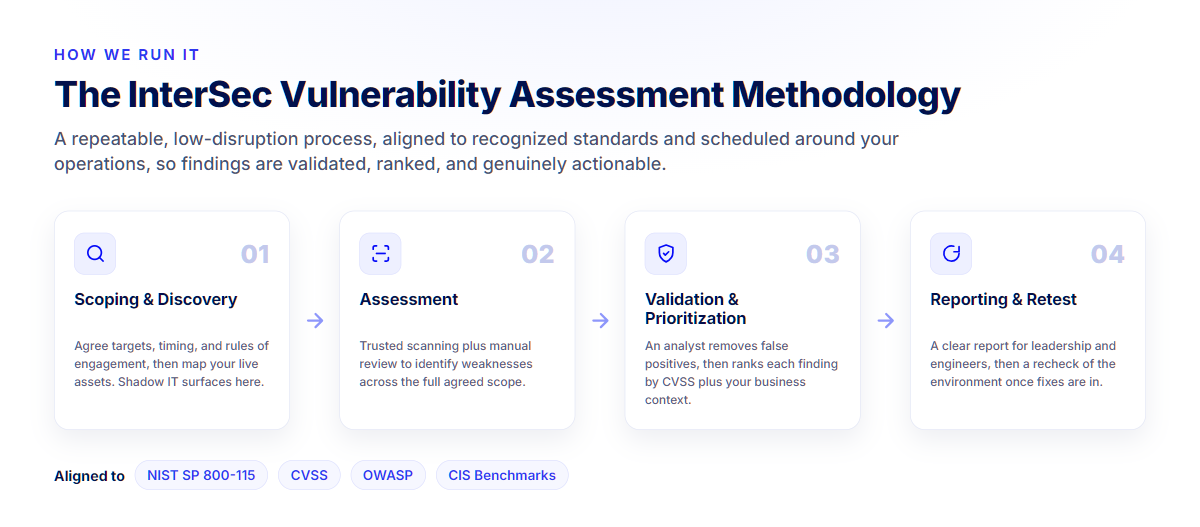
We agree targets, timing, and rules of engagement, then map your live assets, because you cannot assess what you did not know was there. Shadow IT surfaces here.
We combine trusted scanning with manual review to identify weaknesses across the agreed scope, going beyond what any single tool reports on its own.
An analyst confirms findings and removes false positives, then ranks each by CVSS severity plus your business context, so effort goes where the real risk is.
We deliver a clear report for leadership and engineers, then stay available to help your team fix the gaps and recheck the environment once they do.
The NIST technical guide to information security testing and assessment, the backbone of a structured, repeatable methodology widely referenced for federal and DIB work.
The industry-standard way to score severity. We combine CVSS with your business context, so a medium flaw on a critical system can outrank a high one on a test box.
The reference for web and API weaknesses, directing assessment toward injection, broken access control, and the cryptographic failures scanners often miss.
Consensus hardening baselines for operating systems, cloud, and services, used to assess configurations against a recognized, auditable standard.
Want the deeper background on methods and standards? Read our guide to penetration testing and assessments.
The deliverable is not a raw scanner export. It is a validated, prioritized understanding of your real risk, written for the people who have to act on it, from the board to the engineers doing the remediation.
See the real thing. Ask for a redacted sample assessment report on your scoping call, so you know exactly what your team will receive before any work begins.
Request a sample reportRegular vulnerability assessment is not just good practice; several frameworks expect it, and skipping it can stall an audit. We came up through federal and regulated work, so we align assessments and reporting to the frameworks you answer to. Our experience is real: we ran the assessment work behind securing information systems for the Administrative Office of the U.S. Courts.
An assessment is most valuable when it feeds your wider compliance and remediation effort.
From a global IIoT provider securing tens of thousands of devices, to a FinTech firm protecting high-value financial data, to the federal judiciary keeping 22 interconnected systems assessment-ready, here is what analyst-led work actually delivered.

A leading Industrial IoT provider relied on control protocols like Modbus, DNP3, and RS-232 that standard scanning routinely misses. InterSec built a specialized lab that emulated real industrial conditions, ran hardware and firmware analysis, and prioritized findings by operational impact, all while minimizing disruption to live device fleets.
Traditional testing was not surfacing critical vulnerabilities fast enough for stakeholders. InterSec introduced a bug bounty approach focused on valid, high-impact findings, with rapid triage and transparent reporting that reinforced investor confidence.

Sensitive legal data spread across 22 interconnected subsystems that had to stay assessment-ready. InterSec ran advanced assessment and testing alongside policy review and user education, surfacing what routine scans miss and keeping DOJ and FISMA obligations met.
A vulnerability assessment is only as good as the analyst reading the results and the report they hand back. We pair validation and prioritization with the business context that makes findings actionable.
A scanner produces volume; an analyst produces clarity. We validate every finding by hand so you spend your time on real risk, not chasing false positives.
We combine CVSS severity with your business context, so a medium flaw on a critical system outranks a high one on a test box, and remediation effort lands where it matters.
We have assessed environments where oversight is real, including federal judicial systems, the Defense Industrial Base, and regulated commercial industries.
InterSec sells services, not a scanning product, so the only agenda is finding your real risk and helping you close it, not steering you toward a tool.
A vulnerability assessment finds and ranks weaknesses across your whole environment. A penetration test goes deep on a focused set of targets and proves how far an attacker could actually exploit them. Many organizations run both, often together as VAPT.
Most organizations assess quarterly and again after any significant change to their systems. Several compliance frameworks expect assessment on a regular cadence, so confirm the frequency your obligations require during scoping.
No. Scanning is one input. An analyst validates the results, removes the false positives, and prioritizes findings by real business risk. That human step is the service, and it is the difference between a wall of alerts and a plan you can act on.
A ranked list of findings, each with a severity rating, the affected assets, business impact in plain language, evidence, and remediation guidance, plus an executive summary of your overall risk. We can walk you through a redacted sample report on your scoping call.
A focused assessment can take a few days; a large or multi-environment estate takes longer. The active window depends on the size and complexity of the in-scope environment. We confirm a firm timeline with you during scoping so there are no surprises.
CMMC, NIST SP 800-171, PCI DSS, HIPAA, SOC 2, and ISO/IEC 27001 all expect some form of regular assessment. Your exact obligation depends on the framework, so check with your compliance team, and see our compliance penetration testing for testing scoped to each one. Our reports are written to provide the auditable evidence these frameworks call for.
Yes. We provide prioritized remediation guidance your team can work through, and we can recheck the environment once the fixes are in to confirm the gaps are closed.
A short scoping call with one of our practitioners. We will size the assessment to your environment, agree a scope, and give you a clear, fixed quote, with no obligation.