


Network01
Network Penetration Testing
External and internal network testing of firewalls, servers, DNS, and email infrastructure, looking for the real paths an attacker would take to reach your data, not just a list of open ports.
Network, web app, API, and cloud testing that proves your real risk, not a checkbox. Our penetration testing services simulate how a determined attacker would actually breach you, then hand you a prioritized, fixable plan and the evidence your auditors expect.
Penetration testing is a controlled, authorized attack on your systems, applications, or people, run by security professionals to find exploitable weaknesses before criminals do. Unlike an automated scan that only reports known issues, a penetration test proves what an attacker could actually achieve, showing the real path from an exposed entry point to a business-damaging outcome like stolen data or full network control.
Tells you a door might be unlocked. A list of known, potential issues, often noisy and without business context.
Opens the door, shows you what is behind it, and tells you how to lock it for good. Proven, exploitable risk ranked by real-world impact.
Want the full breakdown of methods, types, and standards? Read our complete guide to penetration testing.
Different risks call for different tests. We scope the right type, or layer several, so the engagement reflects how an attacker would really come at your environment, your applications, and your people.
External and internal network testing of firewalls, servers, DNS, and email infrastructure, looking for the real paths an attacker would take to reach your data, not just a list of open ports.
We test custom and public-facing apps, and the APIs behind them, against the OWASP Top 10 and the business-logic flaws scanners miss: injection, broken access control, authentication bypass, and exposed REST and GraphQL endpoints that lead straight to your data.
Most cloud breaches start with customer-side misconfiguration. We validate AWS, Azure, and GCP configurations, IAM policies, and exposed services against the permissions and privilege paths attackers love to abuse.
Connected devices and industrial control systems carry risk that standard IT testing overlooks. We test device firmware, wireless protocols, and control environments like Modbus and DNP3, drawing on field work securing tens of thousands of live industrial devices.
Wi-Fi, Bluetooth, and other wireless connections can hand an intruder a foothold inside the perimeter. We test for weak encryption, rogue access points, and insecure configurations.
People are tested less often than firewalls, and attackers know it. Where it is in scope, we run controlled phishing, pretexting, and baiting to gauge awareness and find the gaps in your human processes.
A goal-oriented, full-scope simulation that chains vulnerabilities across people, process, and technology, mapped to MITRE ATT&CK, to measure how your defenses hold up against a determined adversary.
Not sure which test you need? We help you scope to your real risk, then test what an attacker would actually target, not a generic list.
A professional penetration test is a disciplined process grounded in established standards. We follow recognized methodologies, PTES, the OWASP testing guides, NIST SP 800-115, OSSTMM, and MITRE ATT&CK for mapping attacker behavior, in a clear, repeatable sequence, so the result is thorough, defensible, and reproducible.
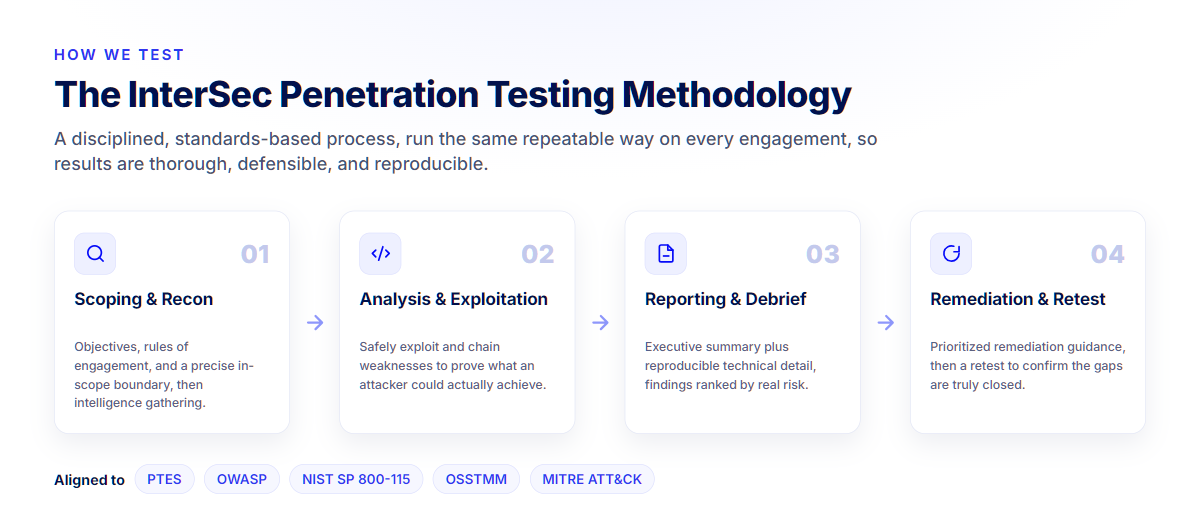
We define objectives, rules of engagement, and a precise in-scope boundary, then gather intelligence on your infrastructure, applications, and exposure.
We formulate attacks from the discovered surface and safely exploit weaknesses to demonstrate what an attacker could actually achieve, escalating and pivoting where authorized.
Every engagement ends with a written report and a live walkthrough: an executive summary that translates findings into business risk, plus reproducible technical detail.
We support your team through remediation with practical, prioritized guidance, then retest the fixes to confirm the gaps are genuinely closed.
A detailed technical guideline built around the attacker's mindset, covering information gathering, exploitation, and techniques for evading modern controls like EDR.
The gold standard for web and API security testing, directing effort toward injection, broken access control, cryptographic failures, and, increasingly, LLM-specific risks.
The NIST technical guide to information security testing and assessment, widely referenced for federal and DIB engagements and structured, repeatable test planning.
Known for quantifiable results, OSSTMM defines metrics that gauge security based on discovered vulnerabilities, their complexity, and their business impact.
For the full methodology, frameworks, and test types, read our complete guide to penetration testing.
The deliverable is not a 200-page scanner export. It is a focused understanding of your real risk, written for the people who have to act on it, from the board to the engineers doing the remediation.
See the real thing. Ask for a redacted sample penetration testing report on your scoping call, so you know exactly what your team will receive before any testing begins.
Request a sample reportThere is no flat rate, because no two environments are the same. The price of a penetration test is scoped to the work: what you want tested, how deeply, and whether the results have to satisfy a specific compliance framework. Rather than sell a package, we scope to your environment and give you a fixed, transparent number before anything starts.
How many systems, applications, or IPs fall inside the boundary you want tested.
A single web app is a very different effort from a full internal network or red team.
How far you want us to push, from surface coverage to deep exploitation and pivoting.
Framework-aligned reporting and evidence for CMMC, PCI, SOC 2, or FedRAMP add scope.
For a fuller breakdown of what drives penetration testing cost, read our complete guide to penetration testing, or book a scoping call for a fixed quote on your environment.
Some frameworks require penetration testing outright; others expect the auditable evidence a good test produces. We came up through federal and regulated work, so we test with the framework in mind from day one and deliver the auditable evidence assessors expect, not a generic findings dump you have to translate. Many teams pair a broad vulnerability assessment with focused penetration testing to cover both breadth and depth. When your test has to satisfy a specific framework, our compliance penetration testing maps each finding to the control evidence your assessor expects.
Testing is most valuable when it feeds your wider compliance and remediation effort.
From a FinTech firm protecting high-value financial data, to a global IIoT provider securing tens of thousands of devices, to the federal judiciary keeping 22 interconnected systems continuously authorized, here is what method-driven testing actually delivered.

A leading Industrial IoT provider relied on control protocols like Modbus, DNP3, and RS-232 that standard pen tests routinely miss. InterSec built a specialized lab that emulated real industrial conditions, ran hardware and firmware analysis, and prioritized testing by operational impact, all while minimizing disruption to live device fleets.

Traditional tests were not surfacing critical threats fast enough for stakeholders. InterSec introduced a bug bounty approach focused on valid, high-impact vulnerabilities, with rapid triage and transparent reporting that reinforced investor confidence.

Sensitive legal data spread across 22 interconnected subsystems that had to stay assessment-ready. InterSec ran red team and advanced penetration testing alongside policy review and user education, surfacing what vulnerability scans miss and keeping DOJ and FISMA obligations met.
Not every penetration testing company delivers the same thing, and the gap between providers is wide. Before you shortlist penetration testing service providers, these are the questions worth asking, and the standard we hold our own work to.
A scan lists potential issues; a person proves what an attacker could do with them. Look for certified offensive specialists (OSCP, CEH, CREST, GPEN) who test by hand.
Ask which standards guide the work. Ours follow PTES, the OWASP guides, NIST SP 800-115, OSSTMM, and MITRE ATT&CK, so results are thorough and defensible.
Testing you can put in front of an assessor is worth more than a generic report. Confirm the provider can map findings to CMMC, NIST SP 800-171, PCI DSS, SOC 2, HIPAA, or FedRAMP.
You should get an executive summary and reproducible technical detail, findings ranked by real risk, and plain-language fixes. Ask to see a redacted sample report.
The job is not done at the report. Make sure the provider verifies your fixes held once your team has closed the gaps, rather than handing over a list and walking away.
A firm that sells software has a reason to steer you toward it. InterSec sells services, not tools, so the only agenda is finding your real risk and helping you close it.
A penetration test is only as good as the people running it and the report they hand back. Our penetration testing consulting services pair offensive skill with the business context that makes findings actionable.
Our testing is run by experienced offensive security practitioners who hold industry certifications including OSCP, CEH, CREST, and GPEN, and who simulate real adversary tradecraft, not point-and-click scanning.
We turn a technical finding into the language leadership acts on: what an attacker could reach, what it would cost you, and what to fix first.
Informed consent, a defined scope, confidentiality, and minimized disruption are built into every engagement, with production systems handled carefully.
InterSec holds the VRS Pentesting BPA with the Commonwealth of Virginia and has delivered testing across FinTech, IIoT, and federal and state programs.
Pricing is scoped to the engagement: the type of test (network, web application, API, cloud, wireless, social engineering, or red team), the size of the attack surface, the depth of testing, and your timeline. A focused web application test is a very different effort from a multi-environment red team exercise.
We do not sell a one-size-fits-all package. The fastest way to a real number is a short scoping call, after which we give you a clear, fixed scope and quote.
Most focused engagements run from one to several weeks end to end, including scoping, active testing, and reporting. The active testing window depends on the size and complexity of the in-scope environment. We confirm the timeline with you during scoping so there are no surprises.
A vulnerability scan is an automated inventory tool that lists potential, theoretical weaknesses, often a high volume of them, without business context. A penetration test is a human-led, intelligence-driven simulation of a real attack that exploits and chains weaknesses to show what an attacker could actually achieve.
Put simply: a scan tells you what might be wrong; a penetration test proves what an attacker could do about it. For a fuller explanation, see our complete guide to penetration testing.
It depends on what you are protecting and why. If most of your risk sits in custom, internet-facing software, a web application and API test is usually the priority. If you are concerned about perimeter exposure, lateral movement, or insider threat, network testing comes first. Many organizations layer both for a complete picture, and we will help you decide during scoping.
An attack surface changes constantly: new code, new systems, and new staff all introduce risk, so a test from even six months ago can be out of date. We recommend at least an annual test, more frequent testing for critical assets, and a test after any significant system change, a major release, or a remediated breach. Several compliance frameworks expect testing on a regular cadence.
Yes, and which apply depends on the framework. PCI DSS, FedRAMP, and CMMC Level 3 require penetration testing outright. CMMC Level 2 / NIST SP 800-171, SOC 2, and HIPAA do not name it, but each is satisfied by the evidence a good test produces, and a proposed HIPAA rule would make periodic testing a requirement. Our reports are written to provide the auditable evidence each framework calls for, while still surfacing the real risk in your environment rather than just checking a box. Our compliance penetration testing page breaks this down framework by framework.
A vulnerability assessment casts a wide net to find and rank known weaknesses across your environment. A penetration test goes deep on a focused set of targets and proves how far an attacker could actually exploit them. Many organizations run both, and they complement each other.
If you need broad coverage and prioritization first, start with our vulnerability assessment services; when you need proof of real-world impact, add penetration testing.
Experienced InterSec offensive-security practitioners, not automated tools running on their own. Our testers hold recognized industry certifications including OSCP, CEH, CREST, and GPEN, and simulate real adversary tradecraft by hand. You work with the same team from scoping through the debrief.
A short scoping call with one of our practitioners. We will help you choose the right test, define a precise scope, and give you a clear, fixed quote, with no obligation.