

Effective POA&M Tactics for CMMC Compliance that Pass Auditor Scrutiny
A practical, 1-stop guide (With POA&M Template) for primes and subs who want to turn “NOT MET” controls into a green light, without annoying their C3PAO
1. Why Plans of Action & Milestones Suddenly Matter So Much
If you sat through a CMMC webinar in early 2023 you probably heard this advice: “Close every gap before the audit. POA&Ms aren’t allowed.”
Not anymore.
The final CMMC rule, published October 15 2024 and effective December 16 2024, lets organizations earn a Conditional certificate even when a handful of security requirements are still open, as long as those gaps live inside a rock-solid Plan of Action & Milestones (POA&M). (Cybersecurity Maturity Model Certification (CMMC) Program)
Working with a qualified CMMC consultant from the outset helps organizations avoid the silent assessment traps that sink otherwise well-prepared contractors.
Contractors who delay preparation risk the consequences detailed in our analysis of CMMC non-compliance costs, including False Claims Act exposure and contract termination that go beyond simply failing an audit.
Understanding what CMMC compliance costs and building a realistic CMMC budget early prevents the scope surprises that derail timelines during the assessment window.
Defense contractors at every stage of preparation should review the Federal Contractor's Guide to CMMC 2.0, which covers all 110 practices, assessment levels, and the scoping decisions that determine how much of your environment falls under evaluation.
For small and mid-sized defense contractors, that change is both a blessing and a trap. The blessing is obvious: you can keep bids moving while you finish the last bits of remediation. The trap is the paperwork, because auditors will tear apart a sloppy POA&M faster than you can say “finding.”
This article walks through the rule, decodes what auditors look for, and shares field-tested tactics that turn your POA&M from a bureaucratic Band-Aid into a document that actually closes gaps on time.
Need help with POA&M? Get our free “POA&M Success Kit” (templates + SMART milestone cheat sheet)
2. The Rule in Plain English, What a POA&M Can and Cannot Do
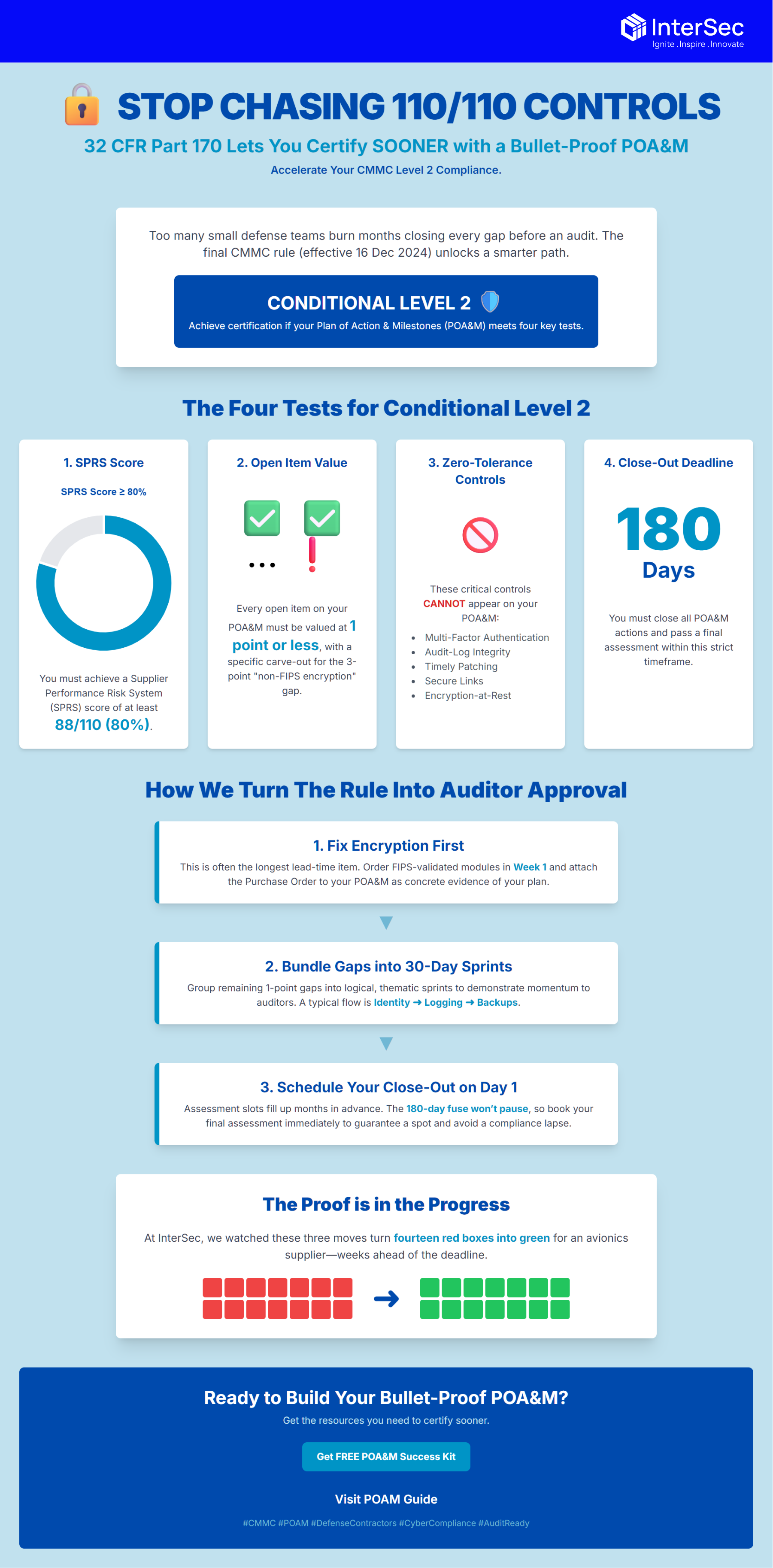
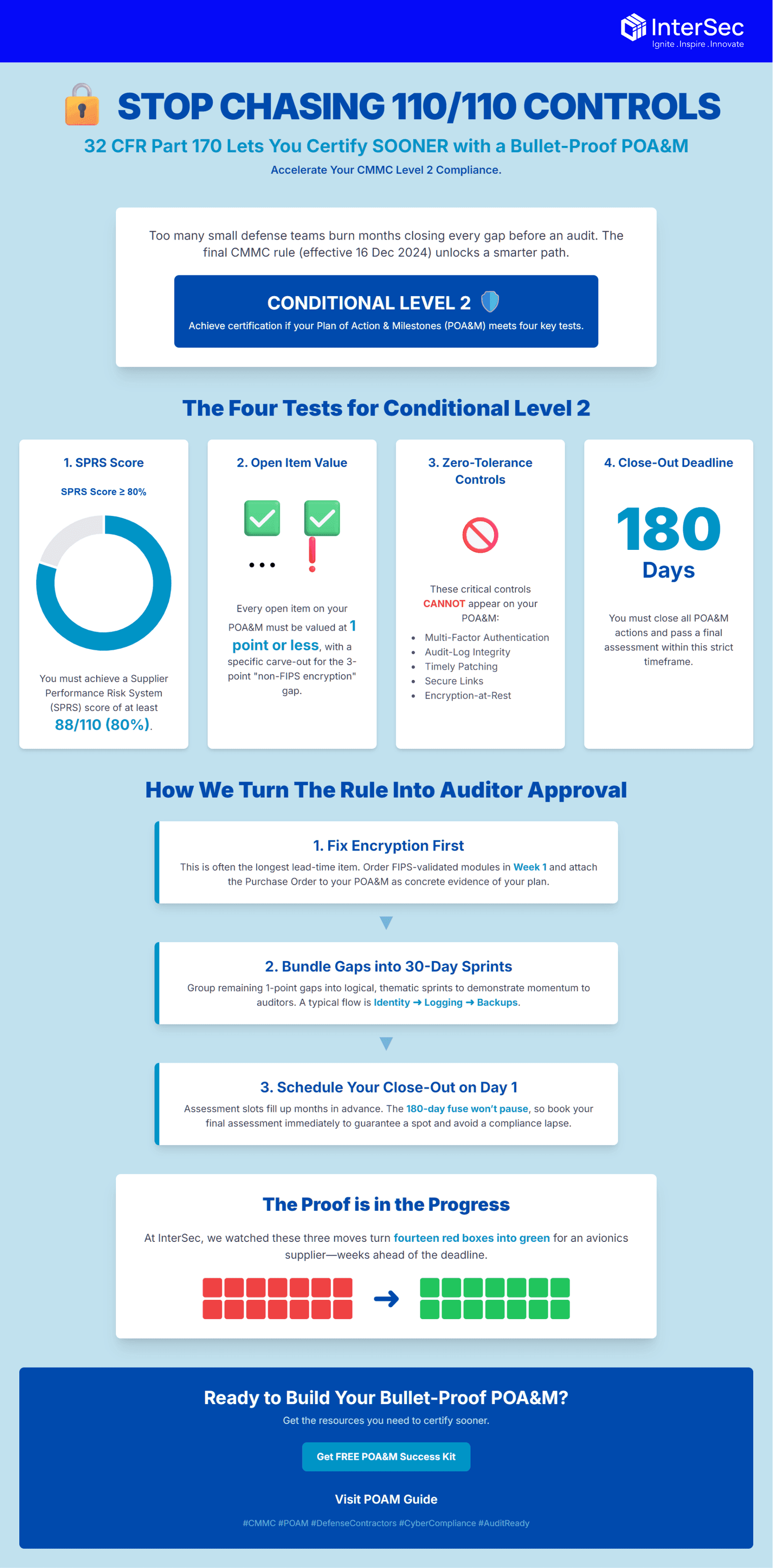
Section 170.21 of the rule sets four bright-line tests: (Federal Register : Cybersecurity Maturity Model Certification (CMMC) Program)
The main point here is that, you can get a Conditional Level 2 with a well planned POA&M. Once you implement all the POAMs within 180 days, you undergo a single POA&M closeout assessment to determine if all the POAMs are closed out in order to achieve the Level 2.
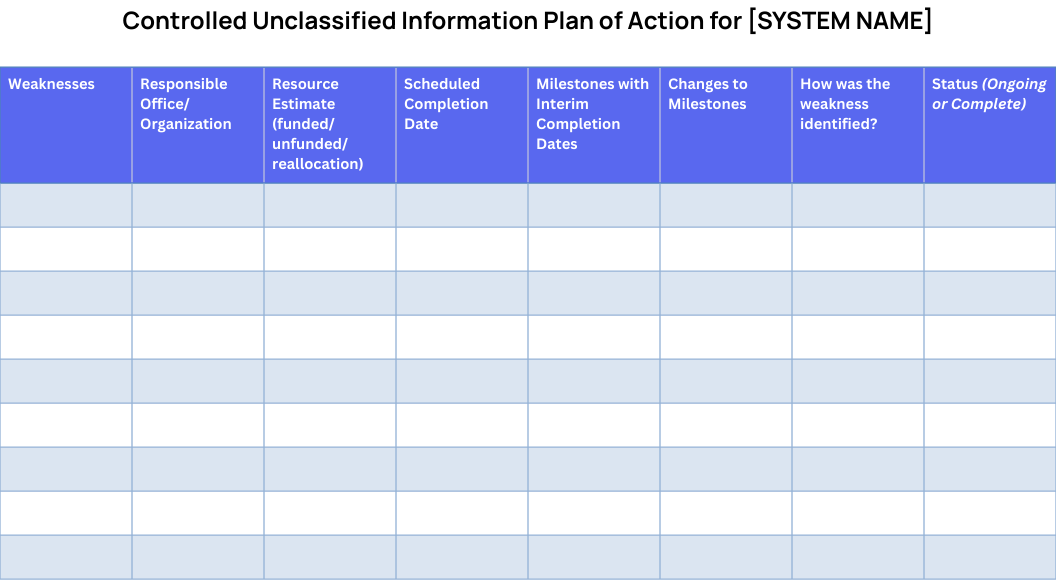
Proper implementation of these requirements must be verified by a second assessment, called a POA&M closeout assessment. If the POA&M closeout assessment finds that all requirements have been met, then the OSA will achieve a CMMC Status of Final Level 2 (Self) or Final Level 2 (C3PAO) as applicable. However, if the POA&M closeout assessment does not validate all requirements have been met by the end of the 180 days, then the CMMC Status of Conditional Level 2 (Self) or Conditional Level 2 (C3PAO) will expire and at this point, standard contractual remedies will apply for any current contract.
- You must already score at least 80 % (that’s 88 / 110) on the CMMC Level 2 scale before any POA&M is accepted.
- Each POA&M item must be worth 1 point or less in the scoring model, except one special case: encryption that is in use but not yet FIPS-validated may carry a 3-point penalty.
- A handful of “show stopper” controls (multi-factor authentication, audit-log integrity, timely patching, secure external connections, and encryption at rest) are never POA&M-eligible. If even one of those is “NOT MET,” you cannot certify.
- Every POA&M has a hard 180-day fuse. Miss that deadline and your Conditional certificate evaporates.
Translated: a POA&M is a privilege, not a loophole. Treat it like a mini-contract with the government, complete with budget, owners, and dates you actually intend to hit.
3. What an Auditor Wants to See in Your POA&M
Auditors review hundreds of these documents a year, so the little details matter. A winning POA&M answers six questions up front:
Auditor's Questions and Responses| Auditor’s Question | Where You Answer It | Why They Care |
|---|---|---|
| Which control is open? | “Control ID” column with full 800-171 reference | Saves time hunting through the SSP. |
| How bad is it? | “Point value” (must be ≤ 1, or the lone 3-pointer) | Proves you know the eligibility rule. |
| Why is it open? | Concise root-cause sentence | Shows you diagnosed, not just observed. |
| How will you fix it? | Action steps tied to budget lines | Gives confidence the plan is funded. |
| Who owns the fix? | Single name + email + phone | Shared ownership equals no ownership. |
| When will you finish? | Milestones no farther apart than 45 days, finish ≤ 180 | Lets the auditor see momentum. |
Notice what’s missing: fluffy verbs such as evaluate or investigate. Auditors reward verbs that do (install, enable, update) because those verbs translate to binary evidence on closing day.
4. Seven Field-Tested Tactics That Auditors Love
- Tackle the 3-Point Encryption Issue Immediately
Non-FIPS encryption is the only 3-point gap the rule allows. Order FIPS-validated modules in week one. Document the purchase order in the POA&M so the auditor knows the lead time is real and the funding is locked. - Bundle Low-Point Controls into Themed “Sprints”
If you have three 1-point gaps in the Access-Control family, group them into a single 30-day Identity Sprint. Bundling shows efficiency and makes the timeline easier to track. - Add Interim Safeguards, Not Just End-State Fixes
Waiting 100 days for new hardware? Note a compensating control (say, explicit IP allow-listing) as “Risk-Limit Step #1.” Auditors see that and think “These folks understand defense-in-depth.” - Attach Proof of Funding Up Front
A screenshot of the approved capital-expenditure ticket or a signed vendor quote kills the “unfunded wish list” suspicion that sinks many POA&Ms. - Write SMART Milestones
“Implement SIEM” is vague. “Enable Azure Sentinel ingestion for 90 days of Windows event logs by May 15” is Specific, Measurable, Achievable, Relevant, and Time-bound, the five qualities auditors are trained to look for. - Update Status Every 30 Days, Inside the Document
Insert a simple % complete column. When the auditor returns for the close-out check, they scroll the timeline and see a living, breathing plan instead of a PDF fossil. - Schedule Your Close-Out Assessment Before You Submit
Most C3PAOs will hold a tentative date six months out. If you wait until day 150 to book, you may blow the 180-day fuse due to assessor availability, not technical work.
5. Mistakes That Trigger Findings (and How to Dodge Them)
Mistake 1, 180 days is a single deadline.
Auditors prefer intermediate checkpoints every 30-45 days. Break a 6-month SSL certificate migration into three shorter tasks: selection, procurement, deployment.
Mistake 2, “TBD” in the budget column.
Even a ballpark “not-to-exceed $2 K” reassures the auditor that the fix is financially real.
Mistake 3, Shared ownership.
Two names in the Responsible Owner box is a red flag. Flip a coin if you must, but give the auditor one throat to choke.
Mistake 4, Evidence Placeholder Empty Until Day 180.
Capture interim artifacts: a delivery receipt, a screenshot of the staging environment, a training signup roster. Show progress, not promises.
Mistake 5, Non-eligible controls sneaking into the plan.
If your POA&M contains a 5-point high-value control, the auditor will end the conversation right there. Cross-check against the CMMC point table before you upload.
6. Keeping POA&Ms Alive with Dashboards and Stand-Ups
Paper plans die on shared drives. To keep yours breathing:
- Dashboard it. A Trello board, Jira Kanban, or even a color-coded Excel Gantt works. The goal is instant visibility: red cards for late tasks, green for done, yellow for “waiting on vendor.”
- Fifteen-minute stand-up. Once a week, every owner says: what’s done, what’s next, and what’s blocking me. Leadership hears blockers in real time and can reallocate dollars or staff.
- Tie status to payments. Some firms refuse to pay the SIEM subscription renewal until the logging POA&M item is officially closed. Instant motivation.
7. A Quick Success Story
A 60-person avionics supplier walked into its pre-assessment with fourteen 1-point gaps, mostly account hygiene and log-review deficiencies. Instead of panic, they ran themed sprints:
- Identity Sprint, MFA tokens for VPN, quarterly account review policy.
- Logging Sprint, Routed firewall and Windows logs into Azure Sentinel, tuned alerts.
- Encryption Sprint, Swapped non-FIPS TLS libraries for validated modules.
They booked their C3PAO for week 10, closed the final ticket on day 85, and passed the close-out with zero residual findings. Their assessor’s comment: “Cleanest POA&M progress record we’ve seen this quarter.” The same approach scaled for a multi-site Navy prime that sequenced remediation to move its SPRS score from -203 toward assessment-ready.
8. From One-Off Plan to Continuous Compliance
Remember, the rule lets you use POA&Ms during certification, but it also requires you to keep your score above 80 % for the life of the contract. That means new deficiencies (say a missed patch cycle or a faulty backup) spawn new POA&M items automatically. A periodic compliance penetration test is one of the most reliable ways to surface those gaps before an auditor does, and to show a remediated control actually holds. Treat the document like an evergreen backlog linked to your change-management system, and the next annual SPRS affirmation becomes painless.
9. Final Takeaway
A POA&M isn’t a loophole. It’s a contract with a countdown timer. Write it with the same care you’d put into a delivery schedule for hardware parts: clear tasks, named owners, real dollars, interim checkpoints, hard finish line. Do that, and your auditor’s biggest question will be “Why can’t every contractor hand us a POA&M like this?”
Need backup? Grab our free “POA&M Success Kit” (templates + SMART milestone cheat sheet) or book a 30-minute readiness call. We’ll button up your POA&Ms, so the auditor doesn’t ding you later.

Talk to a real cybersecurity expert.
Schedule a free consultation. We'll cut through the noise and give you a clear next step.